Sooner or later, anyone who buys or builds links asks the same question: how many backlinks can I add in a month before Google notices? The answers you find online are oddly precise. Five for a new site. Twenty for a mid-sized one. Fifty-plus once you have “authority”. The numbers vary from article to article, which is the first clue that nobody is measuring anything.
This guide takes the question seriously without pretending there is a secret speed limit. It covers what link velocity actually means, where the idea came from, what Google has said about it on the record, the patterns that genuinely make a link profile look manufactured, and a practical way to set a pace for your own site that you can defend to a client, a boss or yourself.
What Link Velocity Means (and What It Doesn’t)
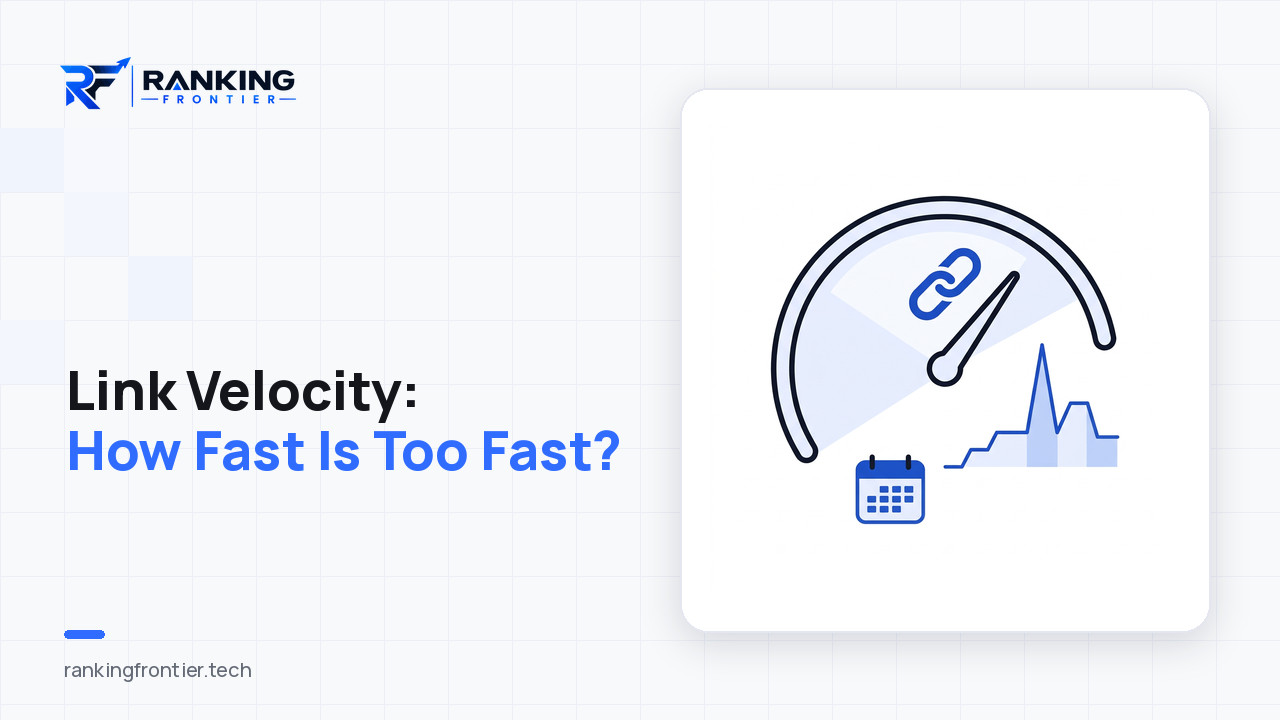
Link velocity is the rate at which a site or page gains backlinks over time. In practice it is almost always measured in new referring domains per month, because a single site linking to you from 400 footer pages is one decision, not 400.
Two refinements are worth making before you go any further:
- Net velocity matters more than gross. Links disappear constantly: pages get pruned, sites close, editors remove outbound links. A site “gaining” 30 referring domains a month while losing 25 is barely moving. Most backlink tools show new and lost domains side by side; look at both.
- Velocity is a description, not a lever. It is a number you read off a chart after the fact. Treating it as a dial you can set to “safe” is where most of the confusion starts.
If you are newer to the topic, our guide to what link building is covers the fundamentals that this article assumes.
Where the Idea Came From: A 2003 Patent
The concept traces back to a Google patent filed on 31 December 2003 and titled Information retrieval based on historical data. Among many other signals, it discusses how a search engine might use the growth of inbound links over time. The relevant passage is worth reading in full, because it is usually quoted selectively:
“Consider the example of a document with an inception date of yesterday that is referenced by 10 back links. This document may be scored higher … than a document with an inception date of 10 years ago that is referenced by 100 back links because the rate of link growth for the former is relatively higher than the latter. While a spiky rate of growth in the number of back links may be a factor used … to score documents, it may also signal an attempt to spam … Accordingly, in this situation, [the] search engine may actually lower the score of a document(s) to reduce the effect of spamming.”
Three things stand out. First, the patent treats fast link growth primarily as a positive signal of freshness and relevance. Second, the word “velocity” never appears; the cautionary language is about a “spiky” pattern that may indicate spam. Third, it is a patent, which describes something Google could do, not confirmation of what the ranking systems do today. Companies patent far more than they ship.
The same document is more specific about what “spiky” means a little later, and it is not about counts. “Naturally developed web graphs typically involve independent decisions,” it says, whereas synthetically generated ones “are based on coordinated decisions, causing the profile of growth in anchor words/bigrams/phrases to likely be relatively spiky.” In other words, the tell is many links that look as though one person chose their wording, not many links.
That nuance did not survive contact with the SEO industry, and “link velocity” hardened into a folk rule: build too fast and you get penalised.
What Google Has Said Since
Google rarely addresses SEO folklore directly, but on this topic its representatives have been unusually consistent.
In 2019, during one of Google’s webmaster Q&A sessions, John Mueller was asked whether building 200 backlinks in two days after years of no link building would be treated as black hat and penalised. His answer, transcribed by Search Engine Journal, moved the question away from speed entirely: “It’s not so much a matter of how many links you get in which time period. It’s really just… if these are links that are unnatural or from our point of view problematic then they would be problematic. It’s like it doesn’t really matter how many or in which time.” He also observed that someone planning 200 links in two days “sounds a lot like” someone buying them, and that the buying, not the pace, is what Google objects to.
In April 2021, asked on Twitter whether building more links than the current number-one result would make a page “stand out as unrealistic”, Mueller replied, “We don’t count links like that,” before adding the usual caution about links you create yourself (Search Engine Roundtable has the exchange).
Gary Illyes went further during a 2019 Reddit AMA, calling link velocity “a made-up term”, a remark Ahrefs records in its glossary entry on the subject.
Read alongside how Google’s link systems have evolved, the picture is coherent. When Penguin became part of the core algorithm in 2016, Google said it “now devalues spam by adjusting ranking based on spam signals, rather than affecting ranking of the whole site.” The December 2022 link spam update extended SpamBrain to “detect both sites buying links, and sites used for the purpose of passing outgoing links”, with the stated effect that “any credit passed by these unnatural links” is lost. The spam policies themselves define link spam by intent and method: links created “primarily for the purpose of manipulating search rankings”, with examples that include buying or selling links for ranking purposes, excessive exchanges, automated link creation, and optimised-anchor links in articles, guest posts or press releases. Paid links are explicitly fine when qualified with a sponsored or nofollow attribute. Not one of these examples references a rate.
So the honest summary is this: Google evaluates links, not link counts per calendar month. Speed is at most a symptom that correlates with the things it does evaluate.
Why the “Safe Range” Tables Exist Anyway
If Google has never published a threshold, where do the neat tables of “5–10 links a month for a new site” come from? Mostly from link sellers, and mostly from each other. Trace the citations and you end up at an earlier blog post that also cites nobody.
The tables persist because they are commercially convenient. A monthly quota maps neatly onto a monthly package, and “we drip-feed your links for safety” is a reassuring thing to say to a buyer. They also offer the comfort of a number in a discipline that is short of them. None of that makes them evidence.
A quick reality check: a well-known SaaS brand that launches a free tool or publishes a widely covered report can pick up hundreds of referring domains in a week. By the tables, that should be catastrophic. In practice it is the most valuable week that site will have all year, because the links were earned for a reason that is visible to anyone, and they carry none of the characteristics Google’s spam policies describe.
What Actually Makes a Spike Look Manufactured
The useful question is not “how many?” but “would this pattern exist if nobody were paying for it?” Natural spikes have a cause and are messy. Manufactured ones are tidy and causeless. The contrast usually shows up across several dimensions at once.
| Dimension | Looks earned | Looks manufactured |
|---|---|---|
| Cause | A launch, report, campaign or news event you can point to | Nothing happened on the site that month |
| Target pages | Mostly the homepage, the asset itself and a few supporting articles | Mostly commercial pages that nobody cites voluntarily |
| Anchor text | Brand names, URLs, article titles, random phrases | The same money keyword, or close variants, repeated |
| Source sites | A mix of sizes and types, most with real traffic and a reason to cover you | Sites that publish ten unrelated sponsored posts a day and rank for nothing |
| Placement | Inside relevant editorial content, often with a mention rather than just a link | Bolted onto old articles, in author bios, or in “guest posts” on general-topic blogs |
| Accompanying signals | Branded search, social mentions and unlinked mentions rise at the same time | Links appear in isolation |
| Rhythm | Irregular: a burst, a tail, then quiet | Suspiciously even: the same number every month, delivered in the first week |
Notice that the right-hand column describes the links, not the number of them. Ten placements with the same exact-match anchor pointing at a pricing page is a worse month than sixty mixed links to a genuinely useful study. If your anchor profile needs attention, our guide to anchor text and placement goes into the detail.
The reason velocity still gets blamed is simple. When someone buys a batch of links, all of the right-hand-column problems arrive together. The spike is what the site owner sees in their tool; the pattern is what Google’s systems respond to.
How to Set a Sensible Pace for Your Site
None of this means pace is irrelevant to planning. It just means the right pace comes from your own data rather than a table. What follows is practitioner guidance, not anything Google has published; it is how we would plan link growth for a site.
1. Measure your baseline
In Ahrefs, Semrush or Moz, look at new and lost referring domains for the last twelve months (Search Console’s Links report shows who links to you, but not the trend). Most sites discover they already gain a few links a month without trying: suppliers, partners, directories, the occasional mention. That organic trickle is your baseline, and anything you add sits on top of it.
2. Look at what your market actually does
Run the same chart for three to five competitors who rank where you want to rank. You are not copying their number; you are learning what link growth looks like in your niche. A B2B software category might see steady low-double-digit monthly growth punctuated by launch spikes. A consumer finance niche might look very different. Pay attention to the shape of their growth and which pages attract it.
3. Decide volume from budget and opportunity, not fear
Your realistic monthly volume is set by how many genuinely relevant placements you can find, qualify and secure with the budget you have. Our link building pricing guide explains why that number is usually lower than people hope. If the answer is six good placements a month, six is your pace. If a digital PR campaign lands forty in a fortnight, forty is your pace that fortnight, and you should be pleased.
4. Shape the mix before you worry about the count
Before any outreach starts, decide roughly what proportion of links should point at commercial pages versus content, what the anchor mix should look like, and what minimum standard a source must meet. Those three decisions protect you far more than any monthly cap. A profile where 80% of new links hit the homepage and articles, anchors are mostly branded, and every source has real organic traffic will survive a busy month comfortably.
5. Give the links a reason to exist
The single most effective way to make growth look natural is to make some of it natural. Publish something worth citing, promote it, and let earned links arrive alongside the ones you secured through outreach. The linkable assets guide covers what tends to work. A spike that coincides with a launch is not a risk; it is a signal that the launch landed.
A Note on Brand-New Websites
“How many backlinks per month for a new website?” is the most common form of the velocity question, and it is slightly the wrong one. The constraint on a new site is not a limit on links. It is that a new site usually has nothing anyone would link to, so any sizeable batch of links in month one is, by definition, unexplained.
A sensible order of operations for a new domain looks like this:
- Get the obvious links that any real business has: partners, suppliers, founders’ profiles, relevant directories, the launch announcement. These carry little weight individually, but their absence is more conspicuous than their presence.
- Publish a small number of pages that could plausibly earn a citation, and make sure they are indexed before promoting them.
- Start outreach once there is something to point at, and expect the first few months to be slow. Our article on how long link building takes sets out what a realistic timeline looks like from a standing start.
Buying fifty links for a three-week-old domain with four pages is not dangerous because of the number fifty. It is dangerous because every one of those links will sit in the right-hand column of the table above.
Drip-Feeding and Other Velocity Theatre
Some vendors offer to “drip-feed” purchased links across the month, or to stagger indexing so growth appears gradual. It is worth being clear about what this does and does not achieve.
Spreading twenty paid links over four weeks instead of one does not change where they come from, what they say, or what they point to. If the placements are on sites that exist to sell links, they are the same placements in week four as they were in week one. Google’s systems are built to recognise those sites regardless of the timestamp, and the spam policies treat links bought for ranking purposes as a violation unless they are marked sponsored or nofollow, whatever their cadence.
What a steady schedule can do is useful for operational reasons: it smooths your team’s workload, spaces out content production, and gives you time to review each placement before the next one goes live. Do it for those reasons. Do not do it in the belief that it launders a bad batch into a good one.
Spikes to Welcome, Spikes to Check
Because velocity is a reading rather than a rule, a sudden change in your chart is information, not a verdict. Most spikes fall into one of three groups.
Spikes you caused on purpose. A product launch, a digital PR campaign, a well-timed study, a founder interview that got syndicated. Record what happened and when, so that in six months you can connect the links to the cause. Nothing else is needed.
Spikes you did not cause but should enjoy. Being added to a widely scraped list, a mention in a newsletter that many sites republish, or a tool that unexpectedly caught on. Check the referring pages, confirm they are real, and move on.
Spikes that look like spam. Hundreds of links from gambling, pharma or hacked sites, frequently with anchors in languages you do not operate in. This is usually scraper noise or an attempt at negative SEO. Google’s own disavow documentation states that “in most cases, Google can assess which links to trust without additional guidance, so most sites will not need to use this tool”. The same page says to disavow only when you have a considerable number of spammy or artificial links and they have caused, or are likely to cause, a manual action, which in practice usually means links you or an agency built. Our guide to running a backlink audit walks through how to tell the difference without over-reacting.
What to Monitor Each Month
If you track link growth at all, track it in a way that would actually catch a problem. A single “new links” figure will not. A short monthly review that covers the following will:
- New and lost referring domains, as a trend rather than a monthly snapshot.
- Distribution by target page: what share went to commercial pages, and whether that share is creeping up.
- Anchor text of new links, flagged whenever a non-branded phrase repeats.
- Source quality: how many new domains have meaningful organic traffic of their own.
- Unexplained changes: any month where growth is more than, say, double your baseline and you cannot name the cause.
That last threshold should be relative to your own history, not a universal figure. For a site that normally gains four domains a month, twelve deserves a look. For a site that gains forty, twelve is a quiet month. If you report link building to stakeholders, our guide to SEO KPIs and reporting covers how to present these numbers alongside outcomes rather than on their own.
It is also a fair question to put to any agency you are considering. Ask how they decide monthly volume for a client, and listen for whether the answer is about relevance, source quality and the client’s own baseline, or whether it is a package size. Our checklist for choosing a link building agency includes this among the questions worth asking.
FAQs
Does link velocity matter to Google?
Not as a standalone signal, based on everything Google has said publicly. Its representatives have repeatedly said that whether links are natural or problematic is what counts, not how many arrive in a given period. Fast growth can accompany a manipulative pattern, and that pattern is what gets evaluated.
How many backlinks per month is safe for a new website?
There is no published number, and any figure you see is an estimate from the person publishing it. A better test is whether each link would plausibly exist if nobody had paid for it. For a new site, that usually means a handful of foundational links early on, then outreach once there is content worth citing.
Can too many backlinks hurt my rankings?
Too many bad backlinks can, through devaluation or, in serious cases, a manual action. A large number of earned links from a launch or campaign is not a problem. The quality, relevance, anchor text and source of the links determine the outcome, not the count.
Should I spread my link building evenly across the month?
Spread it out if that helps your team review each placement properly and keep quality consistent. Do not expect the schedule itself to make low-quality or paid links safer; it does not change what the links are.
Does losing backlinks hurt?
Some loss is normal; pages and sites disappear all the time. It becomes worth investigating when you lose links from pages that still exist, which can mean an editor removed them, a redirect broke, or a competitor replaced you. Reclaiming those is often the cheapest link building you will do.
Conclusion
Link velocity is a useful chart and a poor rule. Set your pace from your own baseline, your market and the number of genuinely good placements you can secure, protect the mix before the count, and give your links a reason to exist. Do that and a busy month is something to celebrate, not something to hide. If you would rather have the pace, mix and sourcing planned for you, Ranking Frontier’s link building services start from your site’s baseline rather than a package size.