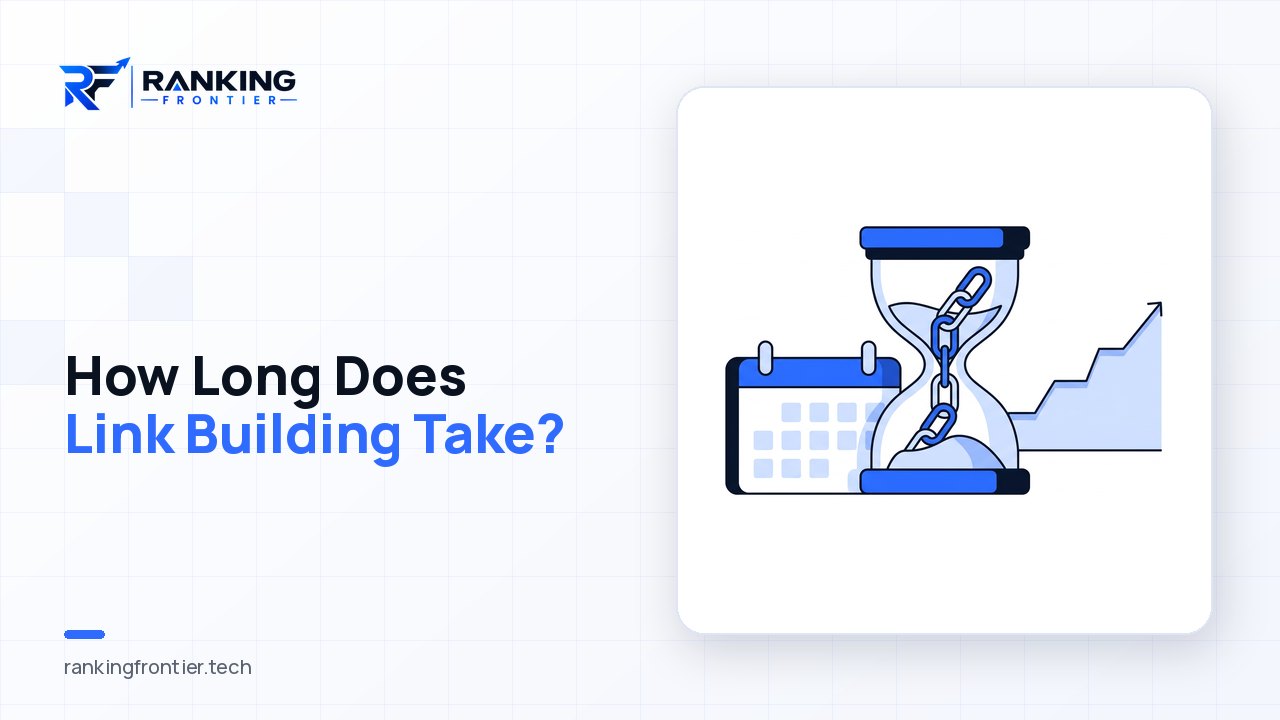
“How long until we see results?” is the first question every client asks about link building and the one most providers answer vaguely. The honest answer is a range, but it is a range with structure: the delay has identifiable causes, each cause has a typical duration, and several of them are within your control.
This article explains why links take time to affect rankings, what a realistic timeline looks like for different situations, what you should see at 30, 90 and 180 days, and how to tell the difference between a campaign that needs more time and one that is not working.
Why Links Do Not Work Instantly
Several things have to happen between a link going live and a ranking change.
1. The linking page has to be crawled
Google discovers a new link when it recrawls the page that contains it. A high-traffic news site may be crawled within hours; a quiet blog might not be revisited for weeks. New guest posts on low-activity sites are the slowest to be discovered because the page itself is new and the site is crawled infrequently.
2. The link has to be evaluated
Once discovered, the link is assessed in context: the relevance of the linking page, the authority of the site, the anchor text, where on the page it sits, and how it fits the pattern of your other links. This is not a single event with a date; it is part of continuous ranking system updates.
3. Your page has to be re-evaluated against the competition
A link changes one input among many. Your page’s ranking only moves when the overall assessment of it changes relative to the pages currently ranking, which may themselves be gaining links and improving content at the same time.
4. Rankings change gradually and unevenly
Movement often arrives in steps rather than a smooth curve, frequently coinciding with broader ranking updates. Weeks of nothing followed by a jump is normal, which is why judging a campaign on a two-week window is misleading in both directions.
A Realistic Link Building Timeline
With those mechanics in mind, this is what we generally see for campaigns built on relevant, editorially placed links. Treat it as a pattern rather than a promise; competitive queries and weak sites take longer.
| Period | What typically happens | What to check |
|---|---|---|
| Weeks 1–4 | Links go live; some are crawled and indexed; little or no ranking change | Links are live, correctly placed, indexed; anchors and targets are as agreed |
| Weeks 4–12 | Early movement on queries where the page already sat on page one or two; impressions begin to rise | Impressions and average position for target queries in Search Console |
| Months 3–6 | Clearer ranking gains on moderately competitive queries; clicks follow impressions | Position changes on target pages; organic clicks to those pages |
| Months 6–12 | Movement on competitive head terms; cumulative authority supports new pages more quickly | Page-level and site-level trend against the baseline |
Published timelines from other practitioners broadly agree with this shape: early signals within one to three months, meaningful movement over three to six, and longer for competitive terms. If anyone promises first-page rankings within weeks from links alone, treat it as a warning sign rather than a selling point.
What Changes the Timeline
Where the page starts
The biggest factor. A page ranking at position 11 to 20 has already been judged relevant; additional authority can move it quickly. A page that does not rank in the top 100 has problems that links alone will not fix in any timeframe.
How competitive the query is
For a long-tail query with weak competition, a few relevant links can produce movement within weeks. For a head term where the top results have hundreds of referring domains each, you are closing a gap that took competitors years to build.
The quality and relevance of the links
Links from relevant pages with real traffic are discovered faster (because those pages are crawled more often) and count for more once evaluated. Cheap links on dormant sites are slow to be found and weak when they are. This is the practical reason quality beats volume; our guide to link building pricing explains what you are actually paying for.
The tactic
Insertions on existing, indexed pages tend to be discovered and counted sooner than new guest posts, which have to be indexed and build their own signals first. Digital PR coverage on major publications is usually crawled within hours.
The state of the page being linked to
Thin content, slow loading, poor internal linking or a mismatch with search intent all blunt the effect of new links. A page that deserves to rank responds to links; one that does not, stalls. Run a quick audit of the target pages before the campaign starts.
The authority of your site overall
Established sites with a healthy existing profile see new links reflected faster than new domains, where every signal is being established from scratch. New sites should expect the longer end of every range.
Link velocity and consistency
A steady flow of relevant links over months reads as natural growth. A burst followed by nothing often produces a temporary lift that fades as competitors continue building.
What You Should See at Each Stage
Because ranking movement is the slowest signal, judge a campaign on leading indicators first.
At 30 days
Every link that was promised is live, on a relevant page, with the agreed anchor and target. The linking pages are indexed (search for the page URL in Google). Nothing has been placed on a site you would be embarrassed by. If any of this is not true, the problem is the provider, not the timeline.
At 90 days
Impressions for target queries should be rising in Search Console, and average position for pages that started on page one or two should be improving. You may see small click increases. If impressions are flat on every target page, review whether the links are relevant and whether the pages have underlying problems.
At 180 days
Clear position improvements on target pages, with clicks following. For competitive terms you may still be mid-climb, but the trend should be visible. If there is no movement at all on any target page after six months of relevant links, something other than authority is holding the pages back, and more links are not the answer.
How to Tell Patience From a Problem
Keep going if:
- Links are live, indexed and relevant.
- Impressions and average position are trending in the right direction, even if clicks have not followed yet.
- The target queries are competitive and the pages started outside the top 20.
Investigate if:
- Linking pages are not being indexed after several weeks (a sign of low-quality sites).
- Impressions are flat or falling on every target page at 90 days.
- Rankings jumped and then dropped back, which can indicate the pages lack the content depth to hold the position.
- Movement is happening on blog posts but not on the commercial pages you were building to, which usually points at a targeting or internal linking problem.
Our article on SEO KPIs and reporting describes how to track this at page level so the signal is visible early.
How to Shorten the Timeline
You cannot make Google crawl faster, but you can remove delays on your side:
- Fix the target pages first. Intent match, content depth, titles, speed and internal links. Links to a ready page work; links to a weak page wait.
- Prioritise pages that already rank on page one or two. These respond fastest and deliver traffic soonest.
- Favour links on pages that are crawled often: active sites with real traffic rather than dormant blogs.
- Mix tactics so some links are counted quickly while slower ones mature. See our off-page SEO checklist for the full sequence.
- Maintain a steady cadence rather than a one-month push.
- Strengthen internal links from newly linked pages to commercial pages so authority reaches them without waiting for direct links.
FAQs
Do backlinks lose their effect over time?
A link keeps contributing for as long as it exists on a page that Google continues to value. Links can lose effect if the linking page is removed, de-indexed, buried deeper in the site, or if the site itself declines. Monitoring your links and reclaiming lost ones is part of ongoing off-page work.
Why did my rankings drop after new links went live?
Short-term fluctuation is common as pages are re-evaluated, and it often coincides with broader ranking updates rather than with your links specifically. A sustained drop after a burst of links with aggressive exact-match anchors is a different matter and warrants a review of the links. A sudden fall across the whole site is usually unrelated to a handful of new links.
Is it faster to build many cheap links or a few strong ones?
A few relevant, editorially placed links on actively crawled pages are both faster and more durable. Large numbers of cheap links are slow to be discovered, weak once evaluated, and carry risk under Google’s link spam policies.
Conclusion
Link building takes weeks to show early signals and months to show clear ranking gains, with competitive queries and new sites at the longer end. The timeline is shortest when the target pages are ready, the links are relevant and actively crawled, and the work is steady rather than sporadic. Measure placements immediately, impressions within the first quarter, and rankings over six months, and you will know whether to be patient or to change course. If you would like a link building programme planned around realistic timelines for your pages, Ranking Frontier’s link building services start with the baseline and the target pages, not with a link count.